
What my time in the Middle East taught me about the future of knowledge work
Three months in, my agents finally got it right.

I should start this post with saying that any views reflected in this post are my own and does not reflect my employer. Last Wednesday I had a long evening of work meetings. The kind where you walk through a stack of open questions about direction, and tradeoffs, and you leave with a set of decisions and a longer list of follow-ups.
Thursday morning I logged in expecting the usual. Meeting transcripts in my inbox, a list of things to write up, the slow drift back to a blank page.
What I got instead was a Slack message. My partner-strategy agent had already read the transcripts, updated the strategy document, reconciled the new decisions with what we had written the month before, and was waiting for my review. The doc was ready to ship. After many months of fine-tuning, it finally got it right.
I had published an essay two days earlier calling these same agents the most incompetent workers I had ever hired. That post is still mostly accurate. Thursday morning was the first time it wasn’t. That was the morning the future stopped being a slide deck and started being my actual job. I want to write down what I think happens next, because I am in an unusual seat to see it.
I am an engineer by training. My first six years were spent writing control laws for helicopters and satellites. Control systems are the closest cousin to AI agents that most people haven’t thought to compare them to. The job of a controller is always the same. Sense the world, take inputs from an operator, make decisions, push outputs back into the world, watch what happens, adjust, do it again. That loop is what an agent is. It is also what I have been thinking about, in one form or another, for twenty years.
After control systems I built data products at PayPal, then analytics for marketing at Facebook, then started a machine learning company that predicted customer lifetime value and got to play with neural networks before LLMs made that table stakes. Since 2022 I have worked with founders building LLM-native products. For the last two years I have been working on agentic workflows and agents at Amazon.
I mention all of this because what I am about to describe sounds speculative, and I want you to know it isn’t.
For most of the past year I have been trying to get Claude Code to work the way an employee works. Not something I wake up by typing a prompt and watch for thirty seconds. Something that wakes up by itself, knows what it owns, reads what’s been happening, and pushes the ball forward.
The technical setup is unglamorous. Scheduled jobs that wake agents every few minutes. A tmux session per agent so I can drop into any conversation as if it were a one-on-one. Each agent owns one of my areas of responsibility. Each one has read access to my email, the Slack channels that matter, and meeting transcripts. There is a shared store of signals the agents write into and read from. When something new lands that touches their area, they draft the next document, draft the next message, or do research in our internal docs.
The default is to move forward. The two times an agent stops and pings me are when it is truly blocked and needs my judgment, or when the next action is something going to a person outside the company. Anything outbound goes through me first.
There is a reviewer agent that reads everything the workers produce before I see it. Every document and every message gets labeled “AI generated” so the reader can grade it with appropriate skepticism. I am pretty sure I am one of the heaviest LLM users at my company. As far as I can tell nobody else has built quite this setup yet.
The architecture is roughly this:
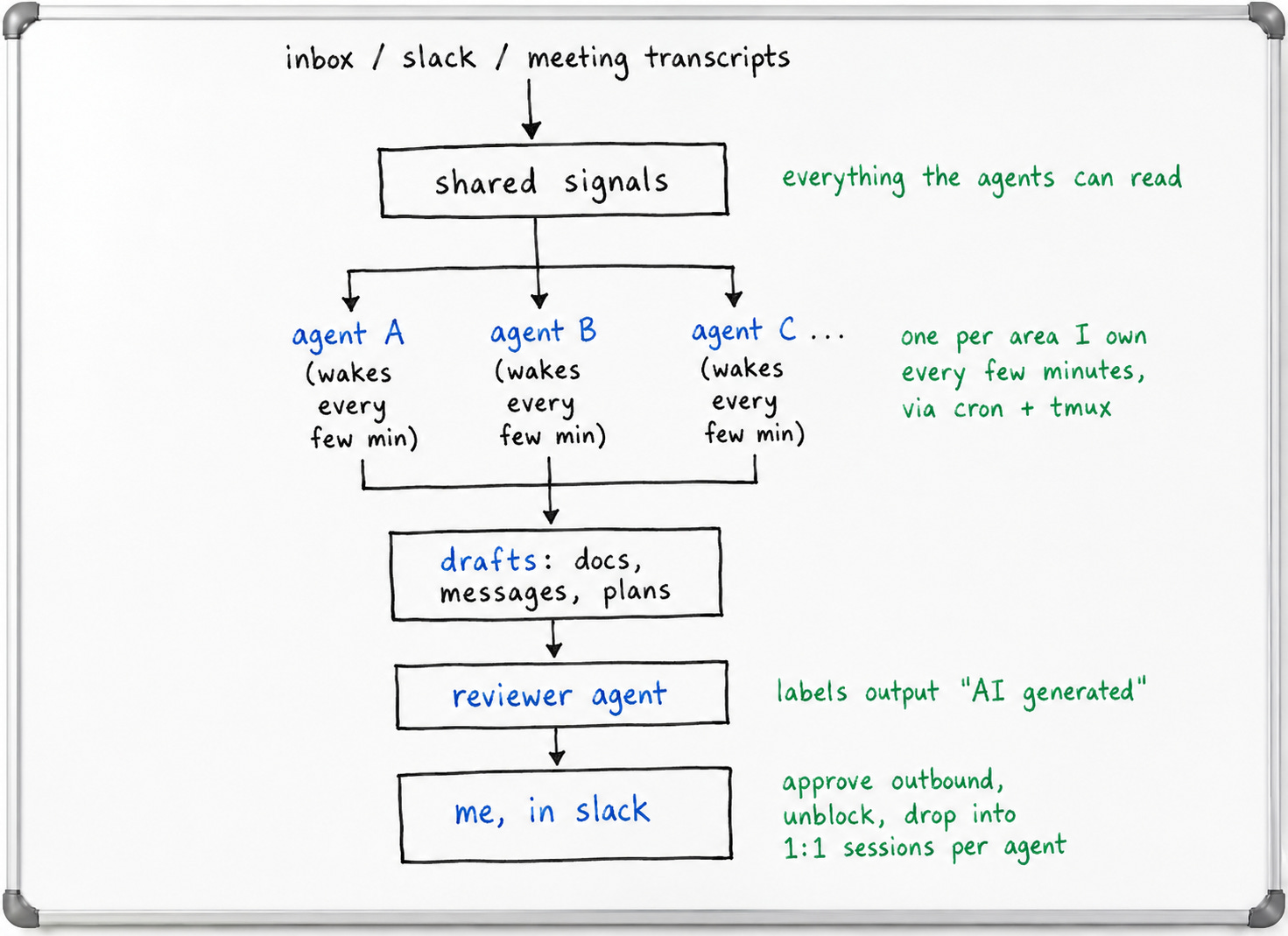
The shift from babysitting to managing was small in code and enormous in feel. Babysitting is when you sit next to the agent and watch a single task. Managing is when you go to bed and wake up to a Slack message that says “I drafted this, look when you can.”
I am not delegating tasks anymore. I am delegating areas.
The mental model I keep coming back to is not from a tech essay. It is from my time in the Middle East as a teenager in the 1990s.
The country I lived in ran on a sponsorship system called kafala. A foreign national who wanted to live and work in the country needed a local citizen as their sponsor, or kafeel. The sponsor’s name went on the iqama, the residency permit. The sponsor took responsibility for the worker, vouched for them, and was often the path through which the worker found their employment.
For a meaningful portion of the local population, being a kafeel was the job. You could start a company and sponsor a team of foreign workers, run a business around what they produced, and take a cut. You could sponsor independently and let your workers find their own employment, in exchange for a fee that flowed back to you. The system covered every kind of work I can think of, from janitors and plumbers to doctors and engineers.
The thing that struck me about this, even at seventeen, was that a real chunk of the workforce wasn’t doing the work. They were responsible for it. They were the interface between local capital and imported labor. They had to know enough to choose well, structure well, and step in when something broke. That was the job.
I keep thinking about this because I think it is roughly what knowledge work becomes.
Most of us in 2026 are still doing our own work. We answer our own emails, write our own docs, run our own analyses. The shift already underway is that more and more of that work moves to agents we own and manage. A senior person five years from now will sponsor a portfolio of agents. They will choose them, train them, deploy them, take responsibility for what those agents produce, and earn a living off the gap between what an agent costs to run and what its outputs are worth.
We are all going to become kafeels.
The analogy isn’t perfect, and the places where it breaks are where the essay gets interesting.
The biggest difference is that imported workers had their own ambitions. They could leave. They could organize. They could take what they learned and move on. Agents can’t do any of that. At first that sounds like it makes the job easier, but I don’t think it does. What it actually means is that the equivalent of career management for an agent is the learning loop. A good kafeel of agents is going to spend real effort making sure every agent gets better at every job. The learning loop replaces the career conversation. If your agent isn’t improving, that is on you, not on it.
The other big difference is maintenance. Agents need power, uptime, and active care. They drift. They break. They forget things they used to know. The kafeel of agents is also their oncall.
There is a fairness concern people raise about the kafala analogy, which is wealth concentration. If the only way to participate in the economy is to own and sponsor agents, what happens to people who cannot afford to or do not know how? I think this is real today, and I think it gets less real over the next few years. Local models are getting good fast. If the trend holds, owning a productive agent will eventually be about as commonplace as owning a laptop, which is to say it will be normal.
The last difference is the one that gives me the most hope. The locals were kafeels because they were born locals. Their permit was a birthright. In the AI version, your permit is your skill at training and managing agents, and that is a craft anyone can learn. The future of knowledge work is more meritocratic than the system I grew up around, not less.

It is May of 2028 and I am at Suncadia in central Washington, sitting in the lodge with a view of the Cascades. There is still snow on the peaks even though it is late spring. It is 7am. I am the owner and operator of forty to fifty agents who run various parts of my business. Some are marketing agents that run campaigns across the social platforms. Some are vertical specialists I licensed from other operators. Some I trained myself over the years. Overnight they talked to each other, traded notes, and resolved most of what came up on their own.
What I am doing this morning is what I do most mornings. I am reading the queue of things they couldn’t resolve. A pricing question that needs my call. A partner conversation that needs me to weigh in before it goes outbound. A strategic shift one of the agents is recommending that I want to think about over coffee.
This is a normal day. The work is still hard, and I still earn a living, but the shape of the day is different. I am not writing the documents. I am choosing which documents matter, and which agents I trust to write them.
If this future sounds far off, the only honest thing I can tell you is that I am already doing about a third of it. I was doing none of it eighteen months ago.
The interesting question is not whether knowledge work moves in this direction. It is moving. The interesting question is what you do today to be ready.
My answer, which is biased because it is what I am doing, is to start sponsoring agents now. Even one. Pick an area you own. Give an agent that area. Give it the inputs that area needs. Set the default to move-forward-unless-blocked. Review its output every day. You will spend the first month frustrated. You will spend the second month tuning. Sometime around the third month, you will wake up to a Slack message with a document that is actually ready to ship.
That is the morning the work changes.