
Real-world AI Workflow: a super-connector's CRM + Claude Cowork
A real-world AI workflow use case every startup CEO at any stage can use to build social capital

A couple of mornings ago I got off a call with Joseph, who runs a cybersecurity company called Discloze. They build software that finds vulnerabilities for their customers. As we wrapped, I had the thought every well-meaning friend has fifteen times a week. I should connect him to someone in my network who might benefit from meeting Joselph. And then I would forget, life happens.
This time, I did something different, I opened the routine I’ve been refining for the last few months. A voice note to the Claude app, three sentences of context. A minute later the system surfaced a name I would not have come up with on my own: Sage, the founder of Jericho, a company I’d met weeks earlier doing adjacent work in the same space. With one click an automated sequence to get the double opt-in went out. By lunch both founders had said yes and email introducing them to each other went out.
That moment is the whole argument of this post, I want to share what I built:
The reason most people don’t build social capital is not character, it’s activation energy required. AI is the technology that lowers that activation energy enough to make the warm introduction a habit instead of a virtue.
What follows is how I came to think about this, what I built around it, and what I think it changes.
The founder-era debt
The pain that produced this routine came from earlier in my career, when I was running venture backed startup Retina AI as co-founder/CEO.
In one of those years I sat down and did the audit and counted how many net-new people I had met that calendar year. The number was a little over two thousand and included investors I was pitching, candidates I was interviewing, customers I was trying to close. Days that ran often sixteen meetings deep. I came out of every one of them with a genuine instinct. This person would benefit from a conversation with that person I met last month. I almost never acted on it.
This is the part nobody admits at conferences. It wasn’t that I didn’t care. It was that by the time I was off the sixteenth call I couldn’t remember the second one well enough to know what the warm intro should even say. The thought of opening a CRM, finding the company, finding the contact, locating the right “notes” field, and typing in what I’d just learned was a tax I would not pay. So the intro lived in my head for forty-eight hours and died there.
Founders I know now do this work diligently. I see them post the open roles their customers are hiring for. I see them tag two people in a thread to make a connection. I admire it and I’m honest with myself that at sixteen meetings a day I did not have that in me.
Why I built my own tool (and why you probably shouldn’t)
The obvious option is an existing CRM, and that option is genuinely good. HubSpot, Salesforce, Affinity, Attio, and a half-dozen relationship-intelligence tools are all built by serious people. If one of them already fits your workflow, keep it. The routine I’m about to describe works on top of any of them.
The reason I ended up building my own is more personal than universal. General-purpose CRMs are designed for a sales rep with a pipeline and a quota. The primary noun is a deal. The primary verb is move-the-deal-forward. That is exactly the right design for the job most CRMs are sold to do.
It is not the job I needed done. The shape of what I was doing is different. The primary noun is a person. The primary verb is help them, and the unit of help is usually an introduction to a third person whose interests you also have to model. “Joseph might want to talk to Jericho” doesn’t map cleanly onto a Salesforce deal record, because there’s no deal. There are two contacts, a thesis about why they should know each other, and a friendly third party who has to say yes to both.
So I built a tool that fits that shape. Five database tables: contacts, companies, introductions, tasks, recommendations-I-owe-someone. Everything else is metadata on those five things. The point is not the schema. The point is what Claude does on top of it.
What the routine actually looks like
The diagram below is the whole loop. There are two ingestion paths, which converge into a single morning brief.
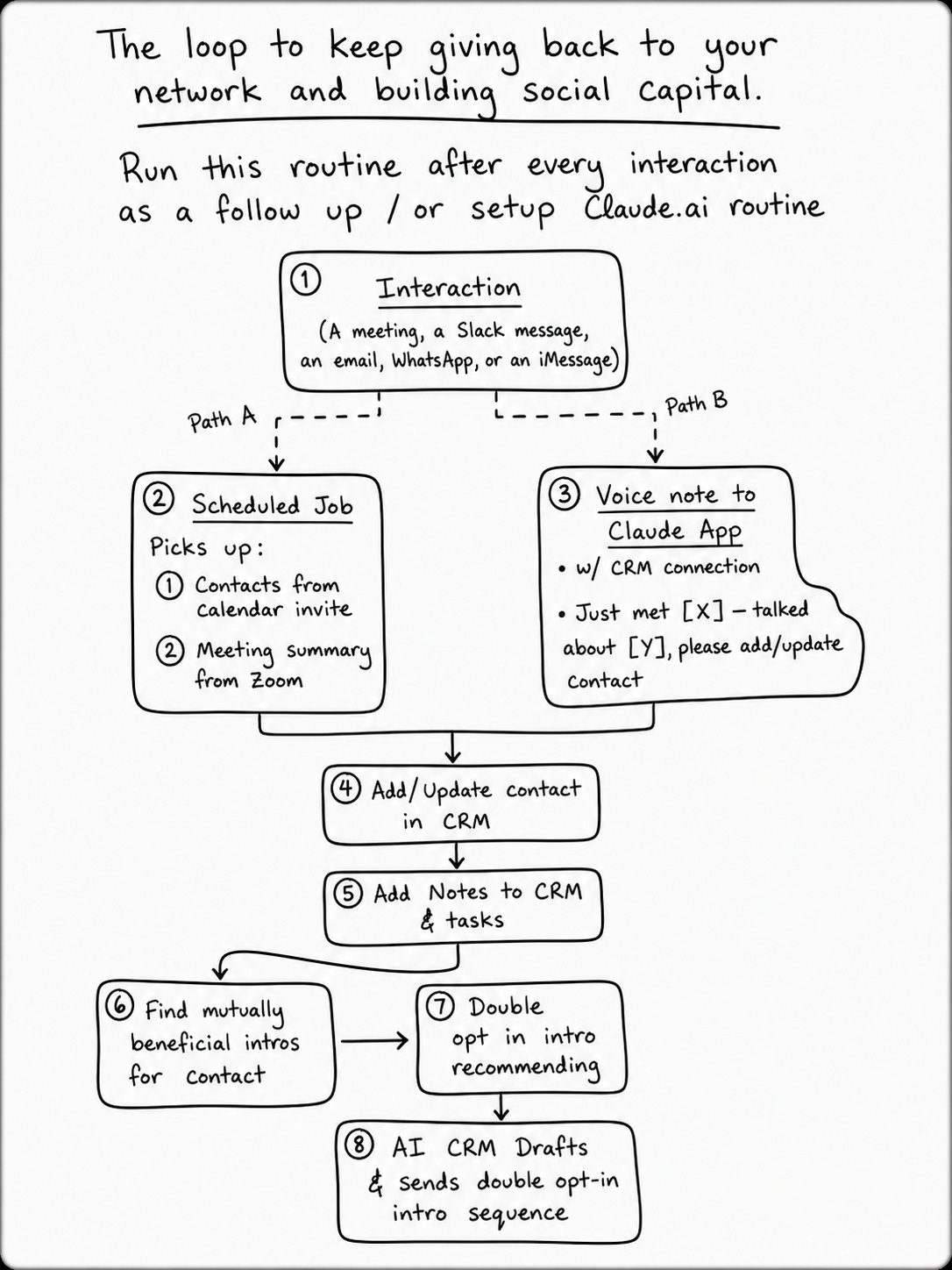
Path A: Calendar-driven. A scheduled job pulls every meeting on my calendar and, when one happens, fetches the Zoom transcript and summary. That summary is dropped into the tool as a note on the contact and the company.
Path B: Voice note. When I’m walking out of an in-person meeting I open the Claude app and dictate three sentences. “Just met X at Y. We talked about Z. Please add a follow-up to introduce them to whoever is working on adjacent problems in my network.”
Both paths feed the same downstream sequence. Contact added or updated. Notes attached. Candidate introductions scored against the rest of the graph. Then I get a brief with what the system thinks are the two or three highest-value introductions from the meetings. I tap approve on the ones I’d actually make myself. Claude drafts, I review, edit and start the the double opt-in email sequence.
The design decision that matters most is that the human still chooses. The system does not send introductions on my behalf. It surfaces opportunities and removes the activation energy. The judgment about who should know whom is mine, because that judgment is also the part of being a connector that earns trust.
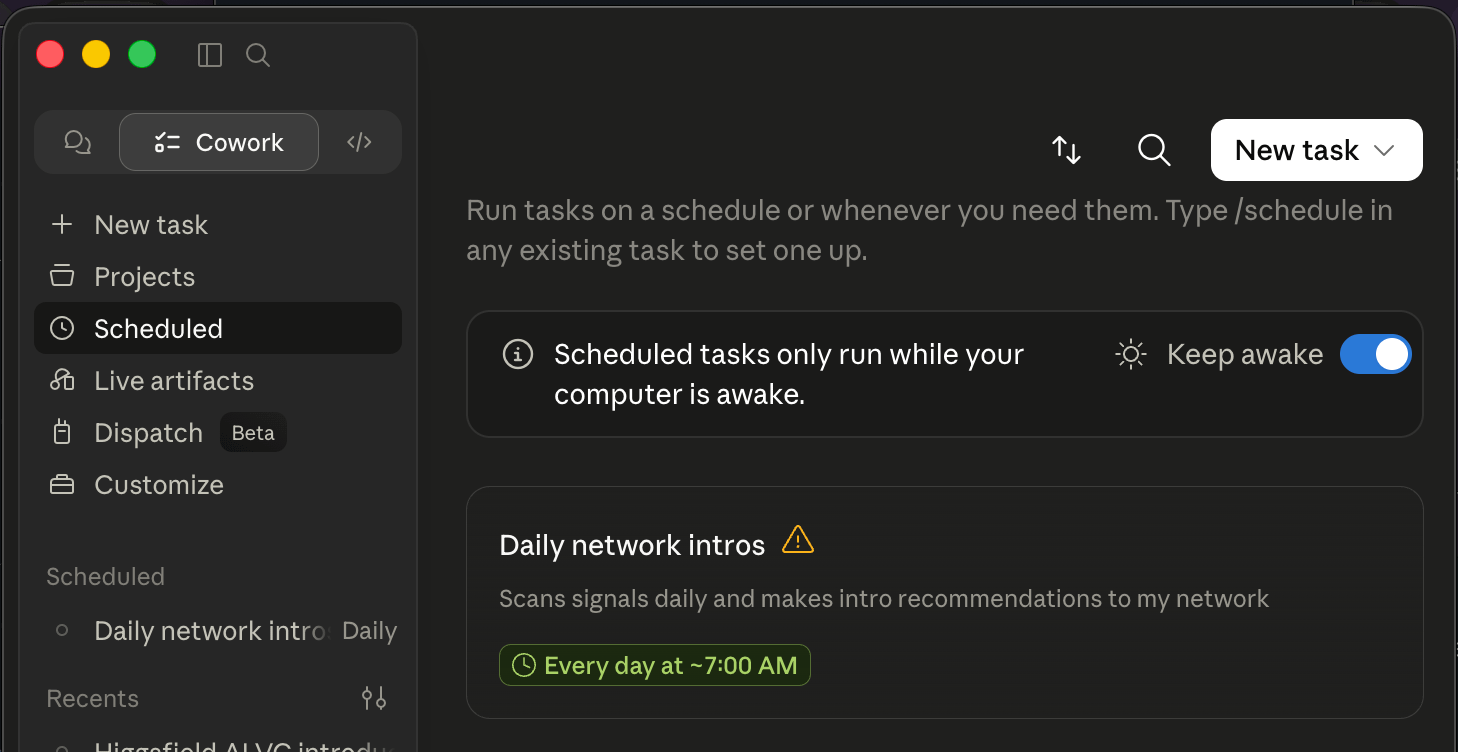
Lastly, you need to do this in a routine, using Claude Cowork’s Scheduled jobs:
If you would like access to the tool or the exact prompt I used comment “prompt” below or reply to this email.
The numbers, and the failure mode
Last month I made 34 introductions through this routine. The hit rate, by which I mean both sides say yes and the meeting actually happens, is currently about 45%. Some of the 55% that don’t land are declines, some are silence, some are bad matches.
I think the 45% number will go up because the recommendation skill can learn from what works and what doesn’t when it matches. The system already knows what I met every person about. The question is whether it can get better at predicting which pairs will produce a real conversation versus which pairs only look promising on a thesis level. That’s an ML problem, but it’s a small ML problem with the right data shape.
The Joseph-and-Jericho case is the one I keep coming back to because I would not have made that introduction without the system. Both founders are in cybersecurity. I had met Jericho briefly weeks ago and the meeting summary was in the database. My brain had not retained it as an associative match. The system had.
The bigger argument
This is the part of the post where I want to be careful not to oversell, because there are good reasons CRMs have failed for everyone except sales reps, and AI does not magically fix all of them.
But I think one specific thing is true. There is a category of behavior that essentially no human does well at scale: keeping in touch, making warm intros, remembering what someone is hiring for, looping back when you read something they’d care about. The reason isn’t that we lack the will. It’s that the activation energy per act is high and the reward is diffuse and delayed. It is the textbook profile of a behavior that loses out to whatever is in front of you on Slack.
The cliché advice for this is “build the habit.” Eat your vegetables. Block time on Friday afternoons to update your CRM. I have watched this advice fail in approximately one hundred percent of cases over twenty years in tech. It does not fail because the people getting the advice are weak. It fails because the activity is structurally hostile to habit formation.
AI changes the structure. When the meeting summary arrives in the database without you doing anything, when the brief shows up in the morning without you opening anything, when the introduction draft is written and waiting for you to read and approve, the activation energy of the act drops from “an hour of friction per week” to “thirty seconds of judgment per morning.” That is the change. It is small in any single instance and enormous in aggregate. I think this is one of the actually-real things AI is going to do in the next few years. Not by replacing human relationship-building, but by lowering the cost of doing it well enough that more people will do it.
The super connector’s playbook used to require either obsessive discipline or a chief of staff. Now it requires a voice note or Claude’s scheduled job.
P.S. The tool I built for this is called Network OS, at thenetworkos.com. It is in very early days and I am not opening it up broadly yet. If you want an invite or the exact prompt, comment or reply to this email and I’ll send one when there’s room.