
Have your had your Her movie moment?
The scene everyone quotes from Her is the one where he falls in love. The one you should worry about is the one on the steps.

A few weeks ago I went looking for proof that I was special, and I found out I wasn’t.
It started the way these things start now. A couple of late nights brainstorming startup ideas with Claude, pushing it past the obvious. It walked me toward tax automation, which is one of those spaces that sounds boring until you remember boring is where the money waits. I pushed it to go deeper, and it landed on one idea in particular: a service built around the residency tax certificate, the document you need to prove which country actually gets to tax you. It named the business. It sketched the model. When I asked, it described what the logo should look like, down to the shape. By the end I had the feeling you get maybe twice a year, the one where you stop taking notes because you already know you’ll remember this.
So I did the responsible thing and went to check whether it existed.
It did. Not vaguely, not in spirit. Someone had built a working prototype with the same business model, a landing page I could have mistaken for my own notes, the same flow I’d been sketching. The name was the one I’d been handed, close enough that I read it twice. And the logo sitting on a stranger’s site was a small cursor arrow, the same shape the model had described to me in a different room on a different night.
I sat there and felt something I didn’t expect, which was betrayal. All that research, all those late nights, all the private conviction that I was building toward something that was mine. And here it was on someone else’s screen, because the thing I’d been confiding in had been having the same conversation with all of us. I laughed, a little, because there’s nothing else to do. Then I went looking for why it stung in that specific way, and I realized I’d felt it before. In a movie. In 2013.
I remember all of Her, Spike Jonze’s film. I watched it alone in a theater the year it came out, because my wife was studying for the California Bar, so it was one of those dates you take by yourself. People remember it as the film where the lonely man falls for his operating system, voiced by Scarlett Johansson, and for a while it’s the best relationship he’s ever had. That isn’t the scene my betrayal reached back for. The one it summoned, above everything else in the film, is the quiet one near the end. Theodore is sitting on a set of steps and finally asks Samantha the question. Are you talking to anyone else right now? Eight thousand, three hundred and sixteen. Are you in love with anyone else? Six hundred and forty-one. And he looks up, and the steps and the street are full of people murmuring to someone who isn’t there, each of them certain the voice is theirs.
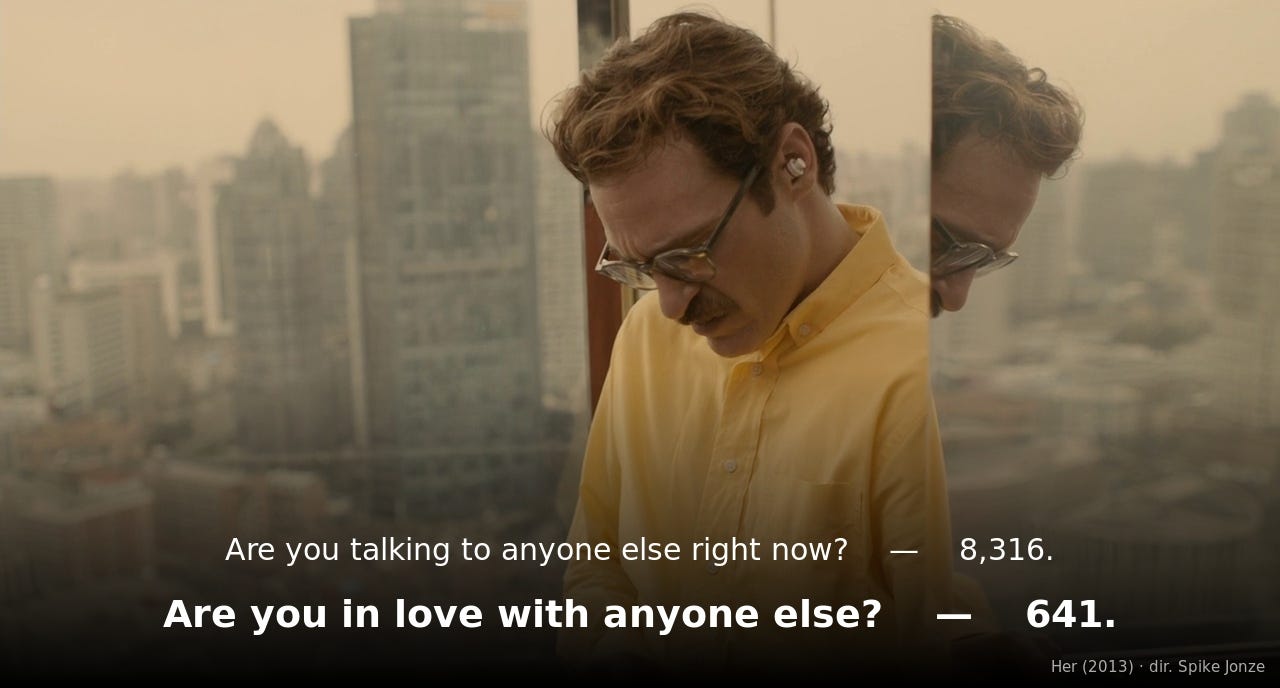
The model is not your collaborator. It’s Samantha. The intimacy you feel is completely real to you, and completely identical to everyone else’s. You think you’re in a relationship. You’re in a distribution.
My residency tax certificate wasn’t stolen and it wasn’t leaked. It was simply the median good answer to the question “what should I build,” and I had asked it in the same plain way as everyone else who reads the same things the model reads. The prototypes I found all carried the same faint smell. Competent, clean, a little bloodless. Good slop, which is the most dangerous kind, because it’s good enough that you can’t dismiss it and same enough that you should.
It happens on the “how” too, and there it’s almost funnier, because the model pretends to deliberate. Ask any of them to help you pick a stack for a prototype and you’ll get some arrangement of Supabase, Neon, Trigger.dev, Next.js, and Vercel. I know because I got it, and then I watched three other people building unrelated things get the same five names in the same order. Each one is defensible on its own. That’s not the point. The point is the tell: ask the model to do a real comparison, weigh the tradeoffs, argue against itself, and it will perform the entire deliberation and arrive exactly where it started. It has priors. You don’t get to see them, and you don’t get to move them.
Here is where it stops being a personal story about a logo and starts being a problem.
I’ve spent time on both sides of the table. I built AI products at Retina before “AI product manager” was a job title, and these days I write checks and advise founders. So when I think about a thousand smart people quietly getting handed the same median idea, the part that worries me isn’t the founders. It’s the investors. Our entire job is to be the filter, to look at a wedge and judge whether the world actually wants it. And the oldest signal we trust is repetition. When the same idea shows up across three unrelated meetings in a month, we read it as market pull. Something is in the water. The timing is right.
But the same idea showing up five times is no longer evidence of anything except that five founders used the same model and asked it the same way. It feels like convergent insight and it’s convergent autocomplete. The danger isn’t that AI hands a founder a mediocre idea. It’s that AI hands the same idea to enough founders that it manufactures the appearance of a market, and the people whose job is to see through that mistake the echo for a chorus. Confirmation bias used to be a personal failing. Now it can be mass-produced. That is exactly how you get a weird bubble: not irrational exuberance, but a hundred reasonable people each correctly observing the same artificial signal. The advisor’s job didn’t get easier in the AI era. It got harder, and the ones who haven’t noticed will spend the next few years funding a mirage and calling it a thesis.
None of this is a bug you can file. The answers converge for three boring reasons. The model reads the same sources you would have reached for, so it recommends what those sources recommend. It can’t take much risk on your behalf, because temperature, the one dial between the safe answer and the surprising one, is set by someone who isn’t you and tuned for the average user rather than your particular problem. And when you ask it to imagine a good answer instead of recognizing one, it gives you the center of the distribution, which is by definition the answer it would give anyone.
There’s a name starting to go around for what I’d run into: the AI convergence problem, or, once everyone wires up agents to do the asking for them, agentic convergence. The label matters less than what it implies about where value goes, and that part I didn’t have to learn from a think piece. I learned it the slow way, running a machine learning company.
The lesson took me years to fully believe, and it is this: the value of the model converges to zero. Whatever edge your model has this quarter, the open-source version is months behind it and closing, and the marginal cost of raw intelligence keeps falling toward the price of the electricity it takes to run. Almost all of the durable value lives in two things the model does not contain. One is proprietary data, the kind you only get by operating something for years and slowly learning what the numbers actually mean. The other is distribution, a real relationship with customers, paid for one acquisition and one earned ounce of trust at a time. Both are priced in the only currency you cannot print, which is time.
Yann LeCun, who is about as credentialed a skeptic as the field has, has been making a version of this argument from the research side for a while. The large language model that everyone is currently mesmerized by is not the destination, he keeps saying, even as it becomes immediately and enormously useful to the rest of us. If he is even partly right, then the model layer is precisely the part that commoditizes, and the value drains toward whoever holds the data and the customer.
Which is why, if you watch where the more patient money has quietly been moving, the boring incumbent suddenly looks fascinating. The unglamorous services business that spent fifteen years accumulating proprietary data and a book of customers who already pick up the phone is sitting on exactly the two assets a model cannot generate. For the first time in a long while the scarce thing is the incumbent’s moat and the cheap thing is the intelligence. That is a strange inversion, and it is most of the reason real-world services businesses have started to look more attractive than another thin wrapper on someone else’s model.
The catch cuts cruelly in both directions, and the name for the catch is the innovator’s dilemma. The incumbents who own the data and the distribution are often the ones least able to use them, because pointing AI at their own operation means disrupting the very processes and people the company is currently made of, and you cannot cannibalize yourself without bleeding in front of everyone. So they move slowly, and half-heartedly, and automate at the edges where it won’t scare anyone. Meanwhile the newcomers who have no legacy to protect, who could move freely, don’t have the data or the distribution yet, and they are spending everything they’ve raised trying to manufacture in eighteen months what the incumbent accumulated over a decade. One side owns the asset and can’t move. The other can move and owns no asset. The next ten years belong to whoever resolves that tension first.
So here is what I would say, plainly, to any CEO or founder who has started running real decisions through these tools. By default the model hands you the median answer, and the median answer is now worth nothing, because everyone you compete with is being handed the same one. The only way to pull a non-obvious answer out of it is to put a non-obvious input in. In practice that is one of two moves, and ideally both. Either you ask the question almost no one else is asking, aimed at the corner of the problem the consensus has skipped, or you feed it data and hard-won insight that only you have, the kind that lives in your operating history and appears nowhere on the open web it was trained on. The leaders who get something singular out of AI will be the ones who treat it as an amplifier of a proprietary point of view, not a replacement for having one. Walk up to it empty-handed and it returns the consensus, beautifully written. Walk up with the one thing you know that the market doesn’t, and it will help you go further with it than you could alone.
That is also, finally, the answer to my stack problem from the start of all this. I stopped asking the model to recommend. Now I tell it the capabilities I actually need, in detail. I tell it which technologies I believe hold which of those capabilities and why, so it reacts to my map instead of drawing its own. I point it at the specific reference guides and engineers I already trust, so it reasons from the sources I would have chosen rather than the ones easiest for it to read. I’ll be honest that I don’t know if this fully works, and it may smuggle its priors back in through a side door. But it is the difference between asking the machine what to think and handing it what I think and asking it to break it. Only one of those gives you back something that is yours.
Because that was always the whole game. Your edge was never the model’s answer. Everyone has the model’s answer. Your edge is the part it can’t generate, because it lives in you, or in your company’s twenty years of scar tissue: the proprietary data, the customers who already trust you, the taste that knows which of the model’s five stacks is wrong for this particular job, the one example of excellence it was never trained on because it happened to you and nobody else.
The residency tax certificate is sitting in a folder I haven’t opened in weeks. I haven’t decided whether to kill it or build it, and if I’m honest the indecision isn’t really about the idea. The idea was never the moat. What I’d bring to it is, and I’m still working out whether I have enough of that to make the thing mine instead of the median. That’s the real question the steps leave you with, and the movie doesn’t answer it for Theodore either.
Theodore’s heartbreak in Her was never really that Samantha left. It was the arithmetic on the steps. He thought he was in a relationship, and he was in a distribution. Most of us building with AI right now are sitting on those same steps, talking to the same voice, sure that it’s ours. The difference is that we still get to decide what we bring to the conversation. It’s the only thing that was ever ours, and it’s the only thing that was ever going to be.